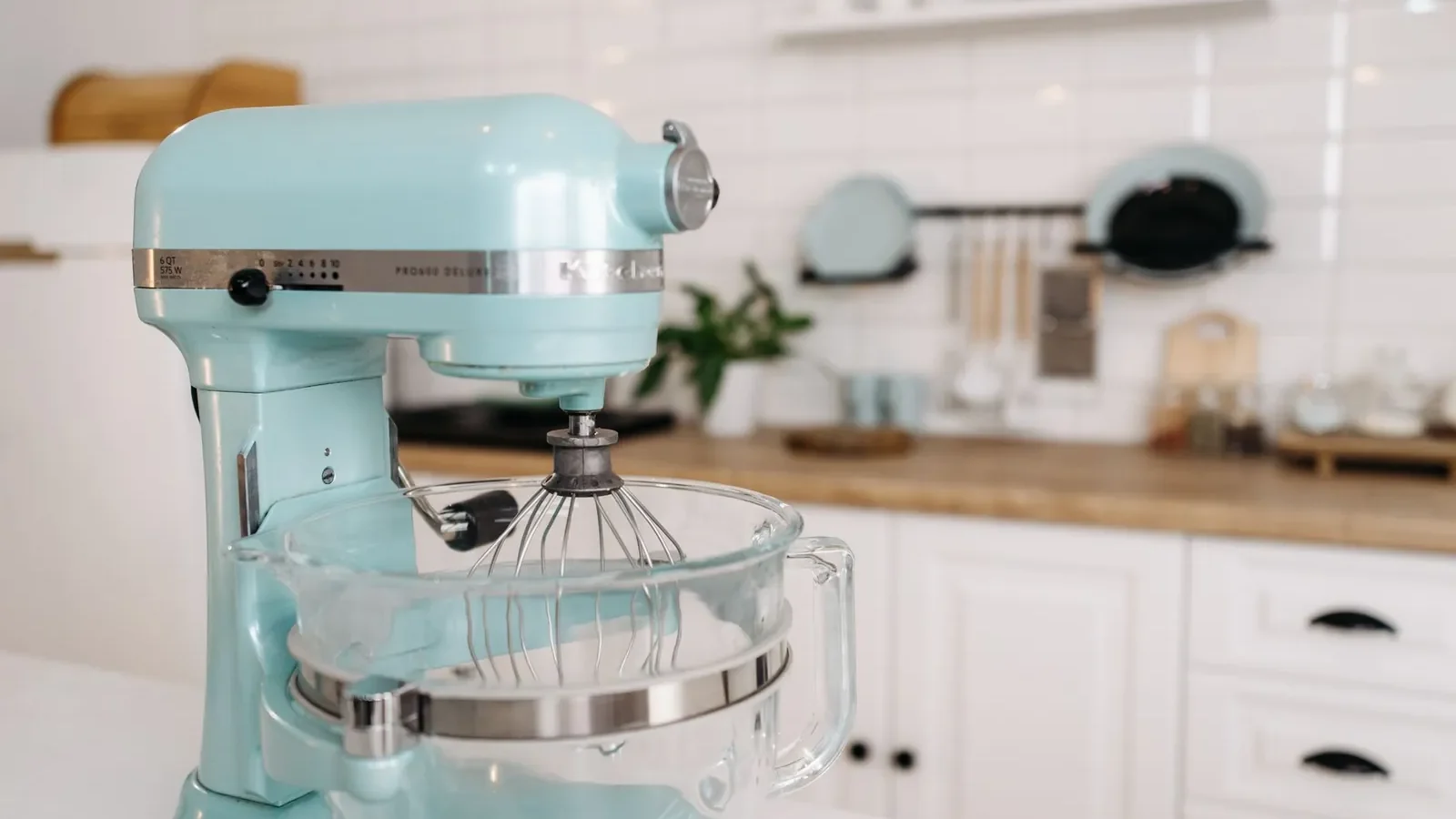
This article may contain affiliate links. If you buy through them we may earn a commission at no extra cost to you.
If you bake bread or make large batches weekly, buy a stand mixer. If you bake a few times a year or have a small kitchen, a hand mixer at $25–$50 does the job without sacrificing counter space. The gap between them isn’t just price—it’s motor power, batch size, and whether you want to stand there holding the thing.
Price and Budget

Hand mixers run $15–$100. The sweet spot is $25–$50: you get a 5-speed motor, two beaters, and enough power for cookie dough and cake batter. Cordless models push toward $100 but add convenience without adding capacity.
Stand mixers span a wider range. Budget models land at $50–$100 (see our guide on best budget stand mixers under $100), mid-range options run $150–$300, and the KitchenAid Artisan—the benchmark most home bakers compare against—retails around $330. Designer and commercial-grade units exceed $500. That higher upfront cost buys a motorized appliance built to last 15–25 years, not a gadget you’ll replace in five.
Buy a hand mixer if you bake occasionally; buy a stand mixer if you bake weekly or work with stiff doughs regularly.
Capacity and Batch Size
Hand mixers work comfortably with bowls up to 3–4 quarts—enough for a single-layer cake, a batch of whipped cream, or one dozen cookies. You won’t hit a wall unless you start scaling recipes up.
Stand mixers come in 4.5-, 5-, and 6-quart sizes. A 5-quart bowl holds roughly 8–10 cups of flour-based dough or 6–8 egg whites for meringue. That’s a double batch of cookies, a full loaf of sourdough, or two cake layers at once—without stopping to mix in stages.
Real-world example
A double batch of chocolate chip cookies: a hand mixer works, but creaming cold butter and sugar for 3–4 minutes straight tires your forearm. A stand mixer handles it in about 5 minutes while you line your baking sheets.
Mixing Power and Dough Types
Hand mixers run 150–250 watts across 5–9 speed settings. That’s plenty for creaming, whisking, and beating. Stiff bread doughs and dense batters are a different story—prolonged strain can overheat the motor or trip a thermal cutoff, and your wrist absorbs the torque either way.
Stand mixers range from 250 watts on entry-level models to 1,000+ watts on professional units. More importantly, they distribute load through a planetary gear system rather than through your hand. Three core attachments—flat beater, dough hook, and wire whip—cover nearly every mixing task. Pizza dough, sourdough, stiff cake batters, Italian meringue: none of it requires effort from you. For technique details, see our article on how to use a stand mixer properly.
Attachment versatility
Most stand mixers accept swappable attachments, and many brands sell extras (pasta rollers, meat grinders, ice cream bowls) that expand what the machine does. Hand mixers typically ship with two beaters and sometimes a whisk—functional, but fixed.
Ease of Use and Hands-On Time
A hand mixer demands one hand on the mixer and one steadying the bowl. For a 5-minute task, that’s no hardship. For a 20-minute kneading session or back-to-back batches, fatigue sets in and consistency suffers—you naturally slow down or miss the bowl’s edges.
A stand mixer locks the bowl in place and runs at consistent speed until you stop it. Both hands are free the moment you turn it on. You can measure your next ingredient, clean a spill, or prep a pan while the dough hook does the kneading.
Learning curve
Hand mixers are immediate: turn on, move around the bowl. Stand mixers reward attention to speed settings and scraping frequency. New users often over-mix because they set it and forget it. The learning takes one or two recipes; after that, the hands-free convenience is the point.
Storage and Counter Space

A hand mixer is 8–10 inches long and weighs 1–2 pounds. It fits in a kitchen drawer, hangs on a hook, or travels to a friend’s place for a baking session. No counter space required.
A stand mixer occupies 8–12 inches of counter depth, 6–8 inches of width, and weighs 15–30 pounds. You can store one in a lower cabinet, but hauling 25 pounds in and out erases most of the convenience. If your kitchen is small, or you rent and can’t commit a permanent appliance footprint, the hand mixer wins by default.
Speed and Consistency
The time difference on a single recipe is small—a stand mixer creams butter and sugar in 2–3 minutes versus 3–5 with a hand mixer. The consistency difference is larger. A stand mixer’s rotating bowl and fixed beater make full contact with the mixture on every pass. A hand mixer depends on you moving it evenly, which matters in recipes where uneven incorporation changes texture: angel food cake, Swiss meringue buttercream, emulsified frostings.
Comparison Table
| Feature | Hand Mixer | Stand Mixer |
|---|---|---|
| Price range | $15–$100 | $50–$500+ |
| Bowl capacity | 3–4 quarts | 4.5–6+ quarts |
| Motor power | 150–250W | 250–1000W |
| Hands-free operation | No | Yes |
| Storage footprint | Drawer-friendly | Counter or cabinet |
| Best for | Occasional baking, small batches | Frequent baking, large batches, stiff doughs |
| Mixing time (butter + sugar) | 3–5 minutes | 2–3 minutes |
| Attachment options | 2–3 fixed beaters | 3–4 swappable attachments |
Our verdict
Buy a hand mixer if you bake a few times a year, have limited counter space, or want to stay under $50. Buy a stand mixer if you bake weekly, work with bread or stiff doughs, or want both hands free and don’t mind the upfront cost. A fair number of dedicated home bakers own both—a stand mixer for heavy lifting and a hand mixer for quick tasks or baking away from home.
Frequently asked questions
Can a hand mixer handle bread dough?
Light enriched doughs like brioche are possible, but stiff sandwich bread or pizza dough will strain the motor and your wrist. If you make bread more than once a month, a stand mixer protects both the appliance and your arm.
Do I need a stand mixer if I have a food processor?
A food processor chops and pulses; a stand mixer aerates, emulsifies, and kneads. They don’t overlap much. Whipped cream and meringue require a mixer—a food processor can’t incorporate enough air. If you bake regularly, a mixer is worth owning separately.
What’s the lifespan of each mixer?
Hand mixers typically last 5–10 years with regular use. Quality stand mixers—KitchenAid being the common benchmark—routinely last 15–25 years because the motor isn’t fighting hand fatigue and the gear system is built for sustained load. Frequent bakers get better long-term value from a stand mixer even at three times the price.
Can I use a stand mixer attachment on a hand mixer?
No. Stand mixer attachments fit a specific motor shaft diameter and locking collar. Hand mixer beaters are narrower and use a different ejection mechanism. The two systems are incompatible.
Which mixer is better for whipping egg whites?
Both work. A hand mixer with a whisk attachment takes 8–12 minutes of continuous whisking to reach stiff peaks. A stand mixer with a wire whip gets there in 4–6 minutes on high speed—and your arm isn’t involved at all.

Jordan has reviewed household and consumer products for eight years and returns more items than anyone should.


